


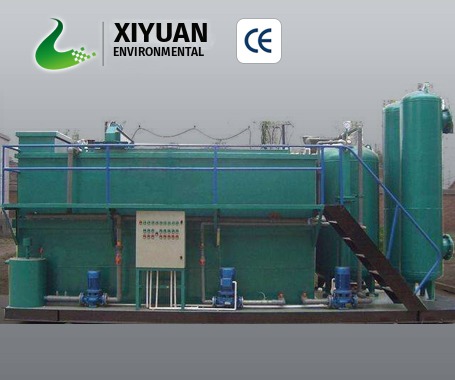
Buried Integrated Sewage Treatment Equipment
Post a Purchase Request
Xiyuan integrated sewage treatment equipment is designed mainly for slaughterhouse wastewater and for domestic wastewater discharged from kitchens, toilets, showers, laundries and other everyday facilities. Such wastewater contains sand, grease, soap, food scraps, bacteria and debris, which shows up in water-quality indicators as high biochemical oxygen demand (BOD5), chemical oxygen demand (COD) and suspended solids (SS), as well as high nitrogen and phosphorus content and eutrophication. If discharged untreated directly into water bodies (rivers, lakes, seas and groundwater) and soil, it raises the concentration of organic matter and causes eutrophication of the water and soil.
Design principles: (1) Strictly comply with national environmental protection regulations and ensure the effluent meets national and local pollutant discharge standards; (2) Use mature, practical treatment processes currently proven in China to reach the treatment targets stably and reliably; (3) Under the above conditions, keep investment and operating costs low; (4) Keep the technical route simple and clear, with convenient operation and management; (5) Adapt to local conditions and build an attractive sewage treatment station on the existing site that harmonizes with the surrounding buildings. Discharge volume, water quality and discharge standards 1. Volume: domestic water for 200 people at 250 kg per person per day gives a daily discharge of 50 tonnes. 2. Water quality and discharge concentrations (typical domestic sewage) BOD5: 100-250 mg/l CODcr: 150-400 mg/l SS: 100-300 mg/l NH3-N: 30-40 mg/l pH: 6-9 Treated effluent quality standard The design effluent quality meets Class 1 of the Integrated Wastewater Discharge Standard (GB8978-96): COD ≤ 100 mg/l BOD ≤ 20 mg/l SS ≤ 70 mg/l Animal and vegetable oils ≤ 10 mg/l pH: 6-9 Ammonia nitrogen ≤ 15 mg/l
Process description: (1) Pretreatment: Sewage leaving the settling tank combines with other domestic sewage and enters the treatment station. A screen chamber removes larger impurities and floating matter, and the sewage then flows by gravity into the equalization tank, which both regulates the flow and balances the water quality. The equalization tank is buried, and grass can be planted on top. After equalization, the sewage is lifted by a sewage pump to the biological tank. (2) Aerobic tank: In the aerobic zone, phosphorus-accumulating bacteria regain their activity and store phosphorus beyond their growth needs in the form of polyphosphate. Energy produced by the oxidative metabolism of PHB/PHV is used for phosphorus uptake and polyphosphate synthesis, and is captured and stored in high-energy polyphosphate bonds, removing phosphate from the liquid phase. The resulting phosphorus-rich sludge is discharged as excess sludge in later process units, removing phosphorus from the system. The entire biological phosphorus removal process is characterized by the synthesis and breakdown of PHB. (3) Sedimentation tank: A structure that separates the sludge carried in the aerobic tank effluent from the clear water. A horizontal-flow sedimentation tank is used here. (4) Sludge treatment system: Sludge undergoes aerobic digestion, and the stabilized sludge is periodically removed by vacuum truck.
Structure of WSZ-F equipment 1. NZP-11 media: Made of special plastics and resin with a scientific, innovative structure, the media has a specific surface area of 1,000 m²/m³ and a low specific gravity of 0.97 g/cm³; it does not clog and readily forms biofilm. It is a spherical media consisting of fine spheres, a mesh shell and a hollow porous core. It simply needs to be added directly with no fixing required, removes hard-to-degrade substances effectively, achieves high removal of nitrogen, phosphorus and sulfides, and produces no excess sludge. 2. Aeration: Central-corridor aeration is used, with the aeration pipes placed in the middle of the tank. During aeration, the air drives the water to circulate to both sides, forming two circulation loops. The tank is round, so there are no dead zones. The small air holes do not clog easily and are easy to adjust and replace. The oxygen transfer rate exceeds 18%, 2-3 times that of ordinary diffusers. 3. Piping: All piping is UPVC, joined with UPVC solvent cement. 4. Screen: Made of stainless steel with 2 mm bar spacing; it does not clog easily and separates effectively. 5. Blowers and control cabinet: The WSZ-F blowers and distribution cabinet are housed in a blower room with two blowers operating alternately. The blower room sits above ground and has a soundproof, rainproof structure.
WSZ-F uses Japanese rotary blowers that are compact, deliver high air pressure and run without vibration, with operating noise below 45 dB and a long service life. These blowers have been used in Japanese septic tanks for 20 years with reliable performance. WSZ-F40-50F uses two Japanese-made three-lobe Roots blowers, 10-20 dB quieter than domestic blowers, with reliable performance and long life. The distribution cabinet uses imported electrical components throughout and a computer simulation control system. Its main control functions are as follows: the two pumps provide automatic standby for each other, with audible and visual alarms when the warning water level is exceeded. The two blowers run alternately; if one fails, the other starts so the equipment keeps running. When sewage flow stops, the blowers run intermittently to protect normal biofilm growth. The control cabinet automatically protects against overcurrent, phase loss, overvoltage, prolonged overvoltage and other faults. 6. Pumps supplied with WSZ-F equipment: Imported Japanese submersible sewage pumps with strong discharge capacity and no clogging, effectively passing solids 30-80 mm in diameter. The pump's shredding mechanism tears long fibers, so no strainer is needed on the pump. WSZ-F equipment comes with two pumps, one on standby, each fitted with an electrical protection switch, float switch and automatic coupling device. 7. WSZ-F filament-wound GRP tank: This equipment and technology reached the international advanced level of the 1990s. In addition to electrically controlled processes from product design to forming, our factory has a complete quality inspection system, a full quality assurance system and a skilled installation team, ensuring scientific design, strict process control, rigorous quality control and fast, accurate installation. With stable quality and reliable performance, our products satisfy our customers.
WSZ-F foundation, installation, operation and maintenance 1. Foundation: If the WSZ-F equipment is placed above ground, simply prepare a concrete slab matching the equipment's footprint as the foundation. The foundation's bearing capacity must exceed 4 t/m², and it must be level and flat. If the equipment is buried below ground, the foundation elevation must be less than or equal to the equipment elevation and rainwater must not accumulate. The foundation is generally plain concrete (reinforcement depending on local geology). To prevent the equipment from floating, anti-floating rings should be embedded in the foundation (see the equipment installation drawing). 2. Installation: Position the tanks one by one according to the installation drawing. Their positions and orientation must be correct and the spacing between them accurate; then connect the piping. Once in place, use straps to tie the equipment to the anti-floating rings on the foundation to prevent flotation. 3. Fill the equipment with sewage and check all pipes for leaks. If there are none, fill the foundation pit with clean water to 30-50 cm, then backfill soil around the tanks up to the inspection openings and level the ground. Connect the control cables from the electrical cabinet to the pumps and the cabinet to the power supply. When wiring, make sure the blowers and motors rotate in the direction indicated on the blowers. 4. Commissioning: The sewage pump feeds sewage into the equipment at the rated flow, and the blowers are started for aeration. Check the media in the contact tank daily; when an orange or yellow film grows on the media (usually after 7-15 days), commissioning is complete. For industrial organic wastewater, it is best to first cultivate the biofilm with domestic sewage, then gradually introduce industrial wastewater to acclimate the biofilm. 5. Maintenance: A regular maintenance schedule must be established for the equipment. The main wearing parts are the blowers and pumps. The blower must never run in reverse. If sewage enters a blower, it must be cleaned and its oil changed before further use. Before starting a blower, check that the air valve is open. Blowers must be serviced every 10,000 operating hours, and pumps every 5,000-8,000 operating hours.
Operating costs 1. Electricity: CNY 0.435 per tonne of sewage treated. 2. Labor: Management requirements are simple; a part-time operator with brief training is sufficient. Chemicals: The system requires no chemical dosing, so this cost is zero. Conclusion: Operating cost (without full-time staff): CNY 0.435 per tonne. PLC control description: The process uses fully automatic PLC program control, working as follows: 1. Automatically starts and stops the sewage lift pumps according to the equalization tank level; 2. Automatically controls periodic sludge return by the sludge pump; 3. Blowers and pumps each have one duty and one standby unit, with automatic switchover; 4. When the equalization tank is empty, the blowers aerate intermittently on a timer; 5. Automatically raises an alarm when the treatment system has a fault.
Classification
GRP product categories:
GRP tanks: GRP storage tanks, hydrochloric acid tanks, sulfuric acid tanks, reaction tanks, anti-corrosion tanks, chemical storage tanks, transport tanks, food-grade tanks, fire water tanks, etc.;
GRP pipes: GRP pipes, GRP sand-filled pipes, GRP air ducts, GRP cable conduits, GRP jacking pipes, GRP process pipes, etc.;
Towers: drying towers, scrubbing towers, desulfurization towers, acid mist purification towers, ion exchange columns, etc.;
Bathrooms: bathroom base trays, bathroom ceiling panels.
Others: angle sections, cable trays, pultruded profiles, tees, crosses, gratings, etc.
Large treatment capacity
Post a Purchase Request
Items marked with "*" are required