


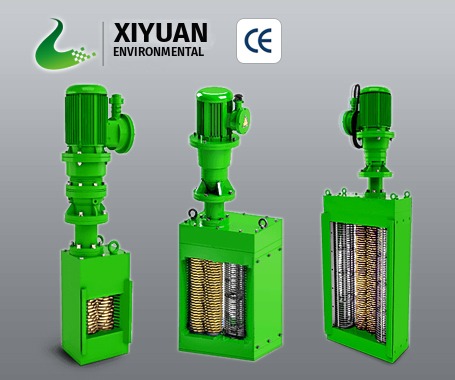
Grinder Bar Screen
Post a Purchase Request
1. Working Principle
After flocculation, wastewater enters the mixing zone and comes into contact with dissolved-air water. The flocs bind with the tiny bubbles in the dissolved-air water, then enter the flotation zone and rise to the surface with the bubbles to form scum. The clear water below flows through the collector to the clear water tank; part of it is recycled as dissolved-air water and the rest flows out through the overflow. The scum on the surface of the flotation tank is scraped into the sludge tank by a scraper and finally discharged.
2. Applications and Features
Air flotation machines offer large treatment capacity, high efficiency and a small footprint, with a simple structure that is easy to operate and maintain. They are especially suited to removing light flocs that are hard to settle, so in recent years they have been used more and more widely in water supply, drainage and wastewater treatment.
3. Specifications and Models
Air flotation machines are available with treatment capacities of 2-300 m³/h and can also be designed to customer requirements. 4. Main Technical Parameters Treatment capacities include 3, 5, 10, 20, 30, 40, 50, 60, 80, 100, 150, 200, 250 and 300 m³/h, and custom designs are also available.
| Model | Capacity | Power (kW) | Dimensions (m) | Pipe Connections (DN) (mm) | ||||||
| (m3/h) | Dissolved Air Pump | Air Compressor | Skimmer | L | W | H | Inlet (a) | Outlet (a) | Sludge Outlet (a) | |
| XYQF003 | ~3 | 1.1 | 0.55 | 0.2 | 3.6 | 2.0 | 2.1 | 80 | 80 | 100 |
| XYQF005 | ~5 | 1.1 | 0.55 | 0.2 | 3.6 | 2.2 | 2.1 | 80 | 80 | 100 |
| XYQF010 | ~10 | 1.5 | 0.55 | 0.2 | 4.6 | 2.4 | 2.4 | 100 | 100 | 100 |
| XYQF020 | ~20 | 3.0 | 0.75 | 0.2 | 5.5 | 3.0 | 2.4 | 125 | 125 | 150 |
| XYQF030 | ~30 | 5.5 | 0.75 | 0.2 | 6.8 | 3.2 | 2.4 | 150 | 150 | 150 |
| XYQF040 | ~40 | 5.5 | 0.75 | 0.2 | 7.8 | 3.4 | 2.4 | 200 | 200 | 150 |
| XYQF050 | ~50 | 7.5 | 1.50 | 0.2 | 7.8 | 3.8 | 2.6 | 200 | 200 | 150 |
| XYQF060 | ~60 | 7.5 | 1.50 | 0.2 | 8.8 | 4.0 | 2.6 | 250 | 250 | 150 |
| XYQF070 | ~70 | 11.0 | 1.50 | 0.2 | 9.5 | 4.0 | 2.6 | 250 | 250 | 150 |
| XYQF080 | ~80 | 11.0 | 2.20 | 0.2 | 10.8 | 4.0 | 2.6 | 250 | 250 | 150 |
| XYQF100 | ~100 | 15.0 | 2.20 | 0.2 | 12.0 | 4.0 | 2.6 | 300 | 300 | 200 |
| XYQF150 | ~150 | 18.5 | 3.00 | 0.2×2 | 10.8 | 6.6 | 2.6 | 250×2 | 250×2 | 200×2 |
| XYQF200 | ~200 | 22.0 | 4.00 | 0.2×2 | 12.0 | 6.6 | 2.6 | 300×2 | 300×2 |
200×2 |
5. Working Principle
After chemical dosing and reaction, wastewater enters the mixing zone of the flotation machine and contacts the released dissolved-air water, so the flocs attach to the fine bubbles. It then enters the flotation zone, where buoyancy carries the flocs to the surface to form scum. The clear water below flows through the collector to the clear water tank; part of it is recycled as dissolved-air water and the rest flows out through the overflow. Once the scum on the surface reaches a certain thickness, the skimmer scrapes it into the sludge tank of the flotation machine for discharge.

1. Clear water tank 2. Clear water pump 3. Control valve 4. Pressure gauge 5. Pressure gauge 6. Air dissolving tank 7. Control valve 8. Air compressor 9. Releaser 10. Skimmer 11. Flotation tank 12. Water collector 13. Ejector 14. Valve 15. Dosing tank 16. Sewage pump 17. Flow meter 18.
Effectively eliminates sludge bulking
Post a Purchase Request
Items marked with "*" are required